NRN to transform monoculture Willow Coppice into biodiverse Wet Woodland
'Right Tree - Wrong Place', we are tempted to say of the 10-acre monoculture Willow coppice by Eynsham Lock. Willow is a fantastic floodplain tree and host to more species than any other, apart from the mighty Oak. However, a Willow coppice (which is harvested in winter with heavy machinery) planted in a floodplain meadow (one of the UK's rarest habitats) is definitely 'Wrong Place'.
NRNers Take Over Eynsham's Willow Coppice
We are extremely grateful, therefore, to our County Councillor, Dan Levy, and the previous Leader of Oxfordshire County Council, Liz Leffman, for helping get the coppice handed over to us for restoration.
It was planted in 2005 in the Neyotts Meadow in front of the Siemens Factory. It was intended to fuel a biomass boiler in Bartholomew Secondary School - before the environmental damage caused by burning wood was fully appreciated. The school never bought the boiler and the coppice was left unharvested for 15 years before the County leased it to a fencing company. The company tried to coppice in winter but, as we all know, Winter floods are frequent in our floodplain meadows and, even when they are not flooding, their soils are fragile when wet and are irreparably damaged by vehicles in Winter.
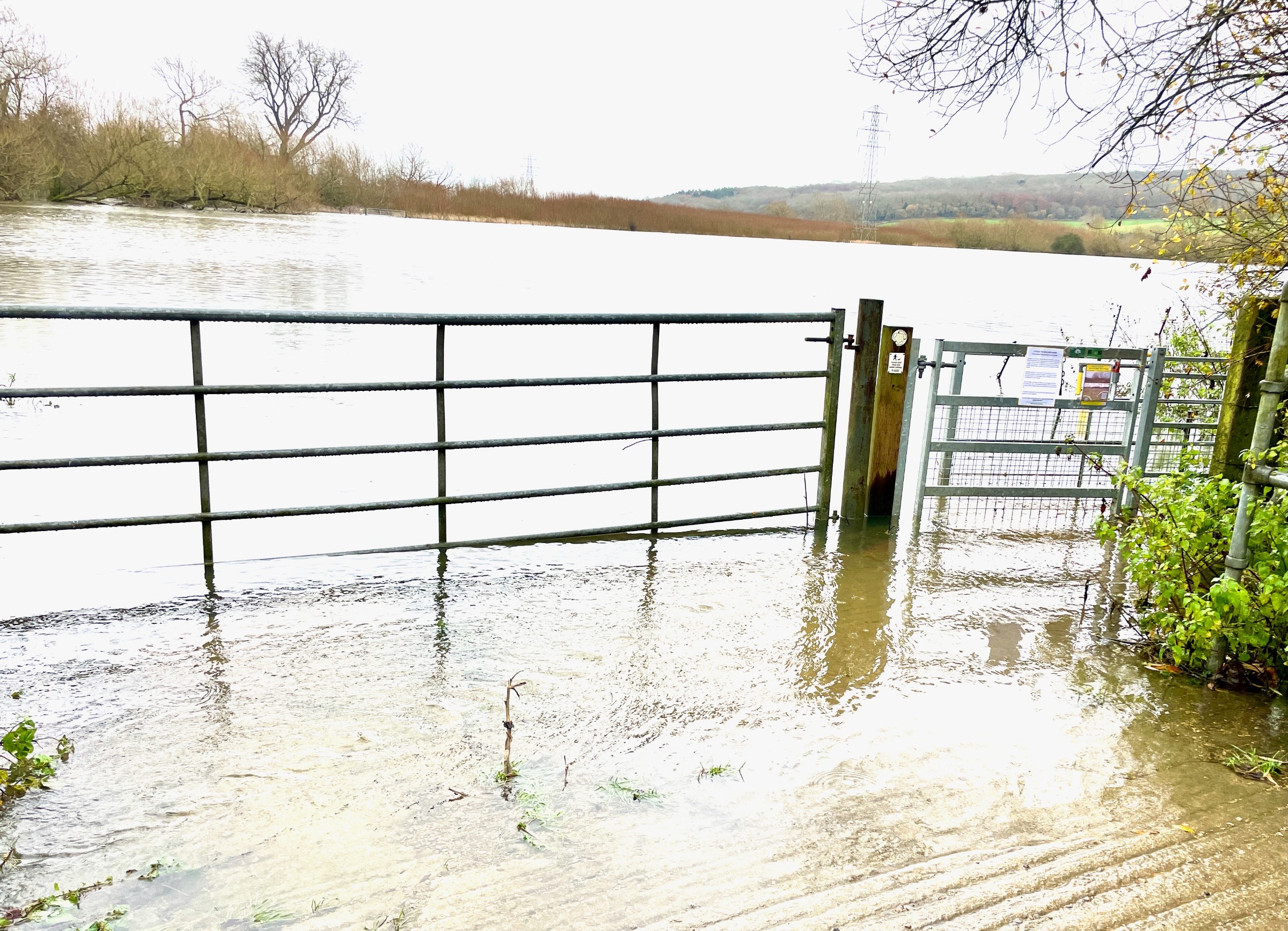 Neyotts Meadow in flood - December 2024
They tried to coppice in Spring - until NRNers (led by our wonderful Nicky Chambers) had several runs-in with them for clear-felling in the nesting season, and they were obliged by the County Council to shift to summer felling.
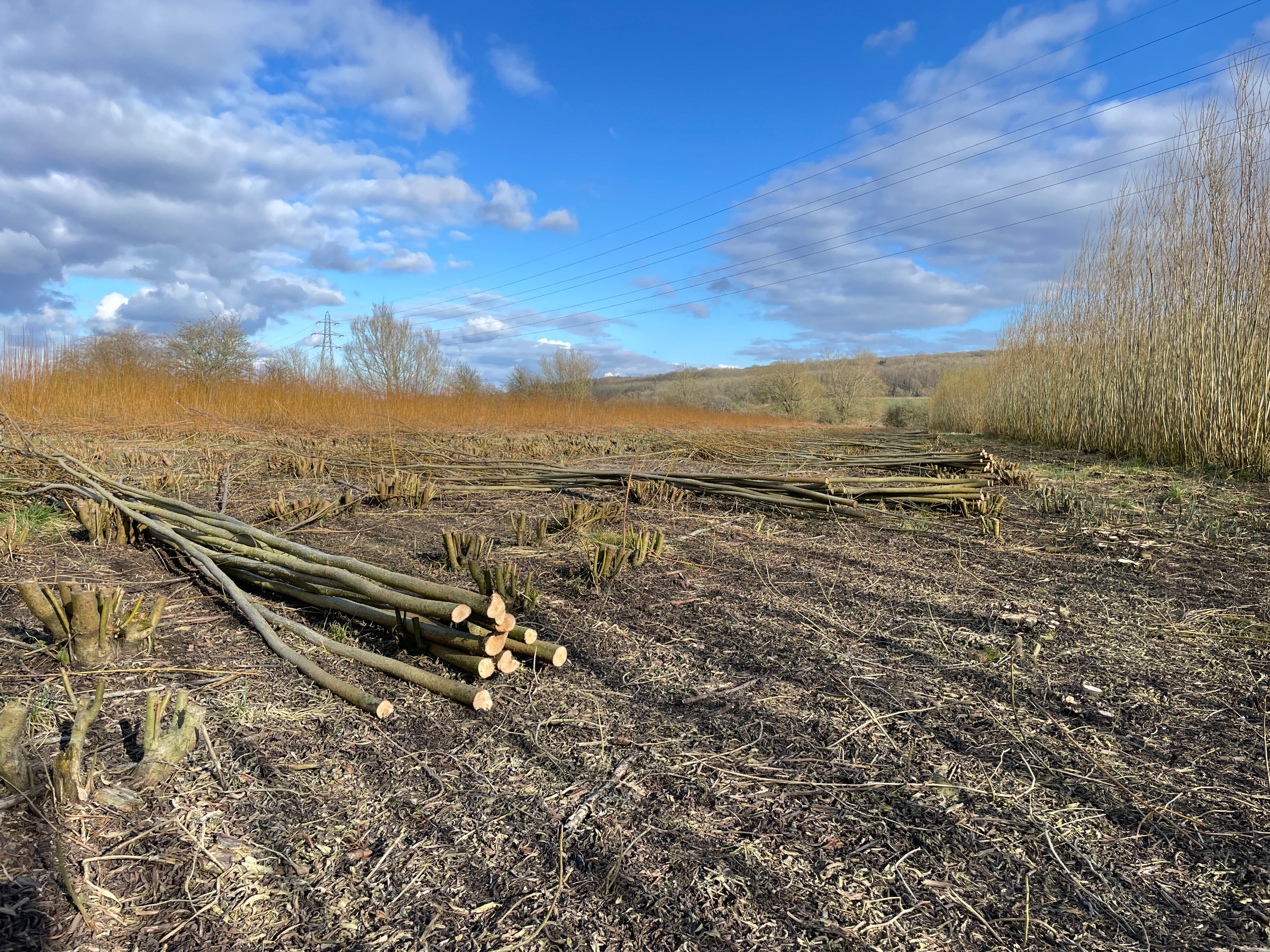 Clear felling the Coppice
Although we can't turn the coppice back into floodplain meadow, a species-rich Wet Woodland is a wonderful alternative and it will enable us to create that all-important 'mosaic' of habitats that is critical to a thriving floodplain. Wet woodland is one of the UK’s rarest habitats and provides for a range of floodplain animals. Our surveys show that the Willow Coppice already hosts otter and water vole.
Wet Woodland is also critical to flood mitigation as the trees absorb water and slow the flow across the landscape. So, in creating a new Wet woodland we and can play an important role in natural flood management, bringing added resilience to communities and infrastructure downstream.
Typical wet woodland species include Willow, Alder, Downy birch and Black poplar, although, many other tree species also thrive in our increasingly flooded floodplains. We are not going to be too purist in our approach, particularly since hawthorn is already growing naturally among the willow and undoubtedly other species will find their way in as we create space and light. We are planning to devote an area of the coppice to create a Living Library of the native Black poplar trees that we are beginning to identify around West Oxfordshire as part of our Black Poplar Project.
Our plan is to restore the woodland slowly over time, so that instead of a new plantation with trees all of the same age, which can have limited environmental value, we will be creating something more akin to a natural woodland with trees of differing ages. We will leave some areas to regenerate naturally, enabling us to compare, over time, the relative success of a 'rewilding' approach with the more conventional tree-planting strategy.
Standing and fallen deadwood is a critical habitat in a woodland, particularly for saproxylic invertebrates, which are at the bottom of the woodland food-chain. They depend on dead, dying and decaying wood and its attendant fungi and microhabitats. Deadwood, in quantity, can be absent for decades in newly planted woodland. So, rather counter-intuitively, since our efforts to date have been focused on growing plants to survive for generations, we are planning to grow Ash and Elm, in order to get standing deadwood, earlier than normal.
We will keep some sections of willow to coppice to create binders for hedge-laying, for fencing and for riverbank restoration - as well as for Eynsham's wonderful Willow Coppice group (led by Andy Goodwin and Charlotte Holmes) to help us make beautiful art and craft works.
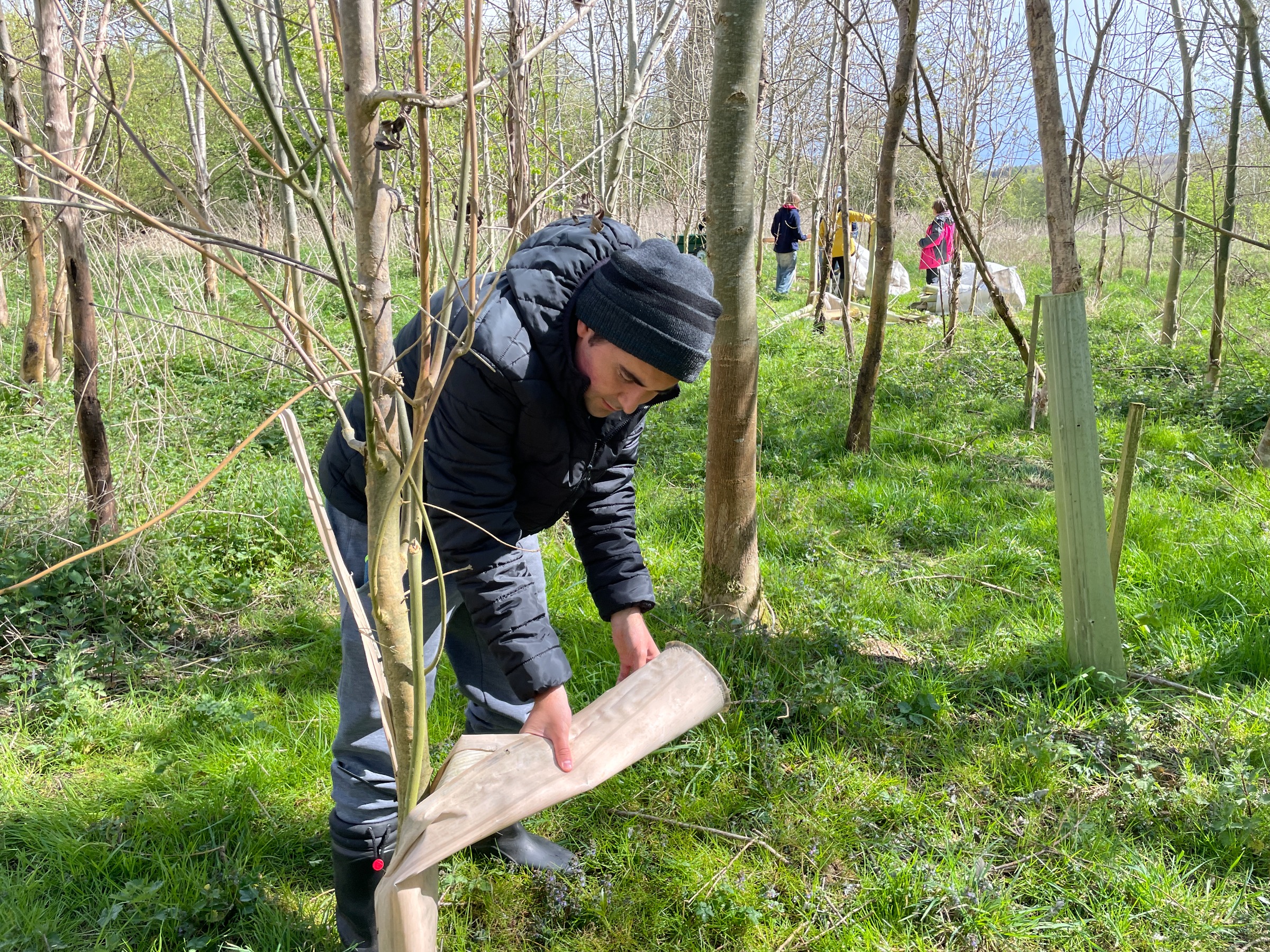 Removing 20 year old tree guards
Eager to get going, we snuck in even before it was officially ours. We put up bird boxes and started removing hundreds of 20-year old plastic tree guards that were throttling the trees and frittering their plastic into the landscape and floodwaters.
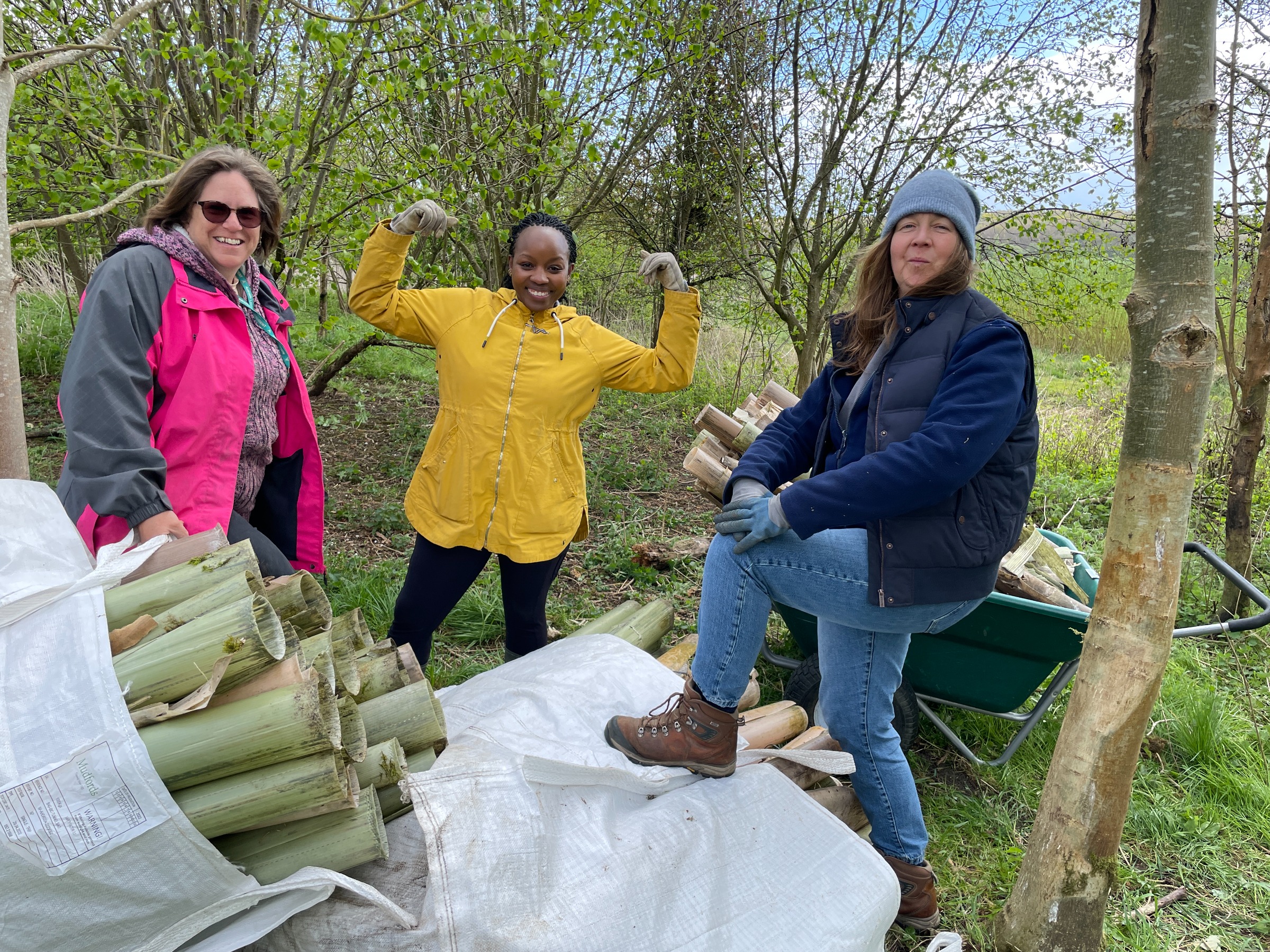 Celebrating success!
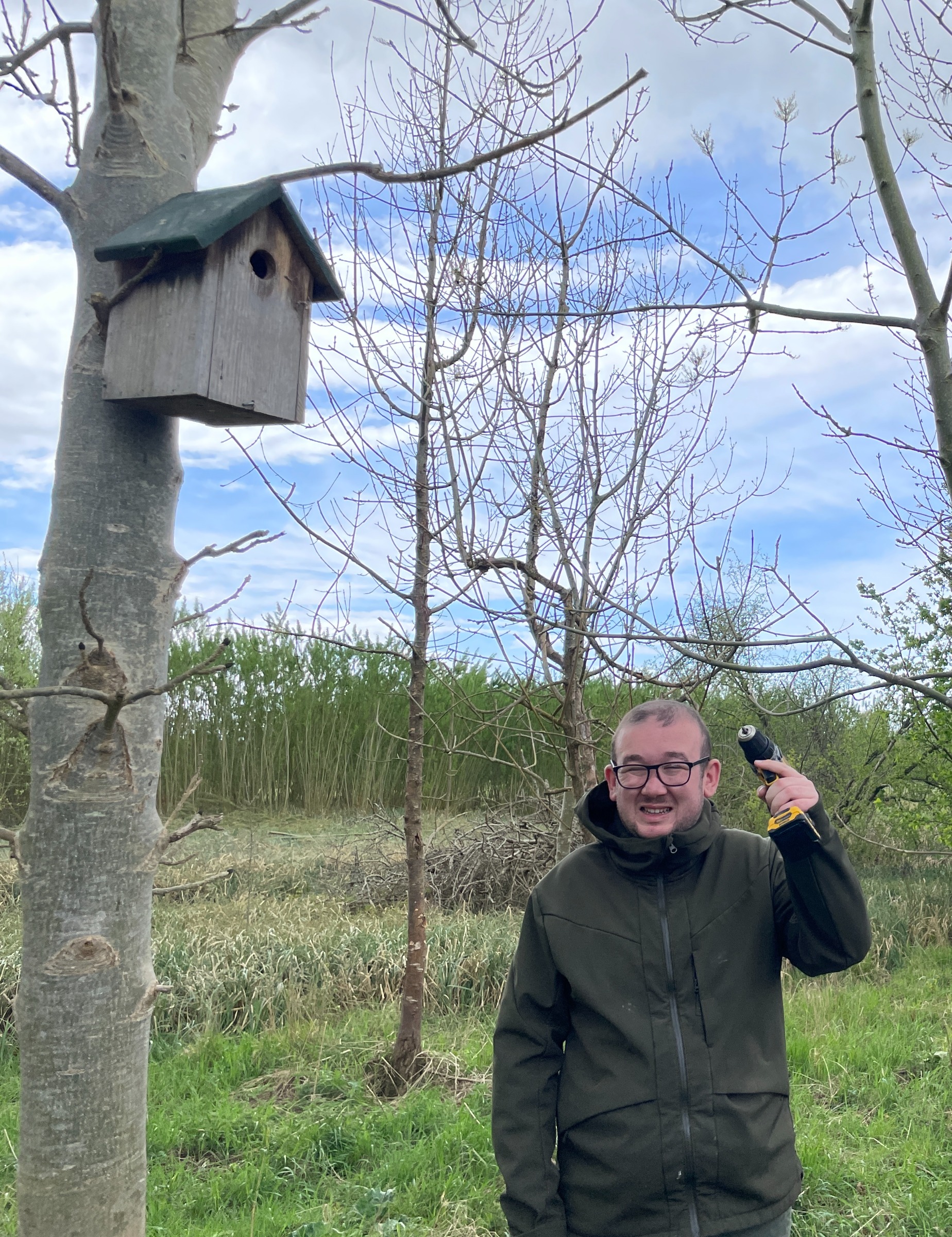 Putting up bird boxes
Our first major job is to deal with the debris left by our predecessors. They laid waste to the coppice before departing, strewing discarded coppiced wood over the whole ten hectares. 'It's like walking on a massive woodpile,' one of our NRNers said, confessing that it was first day in 3 years that she hadn't enjoyed...
We are now trying to gather all the fallen stems into piles. The acquisition of a woodchipper, (with grateful thanks to West Oxfordshire District Council) is making a huge difference to our clearance efforts. Importantly, it is also providing masses of lovely woodchip to create our zero-miles compost, in which we grow our rare plants.
This spring, we spent some time trying to determine the least invasive, most eco-friendly (and cheapest) way of removing some of the serried ranks of White willow, in order to make space for the new trees that we are planning to propagate.
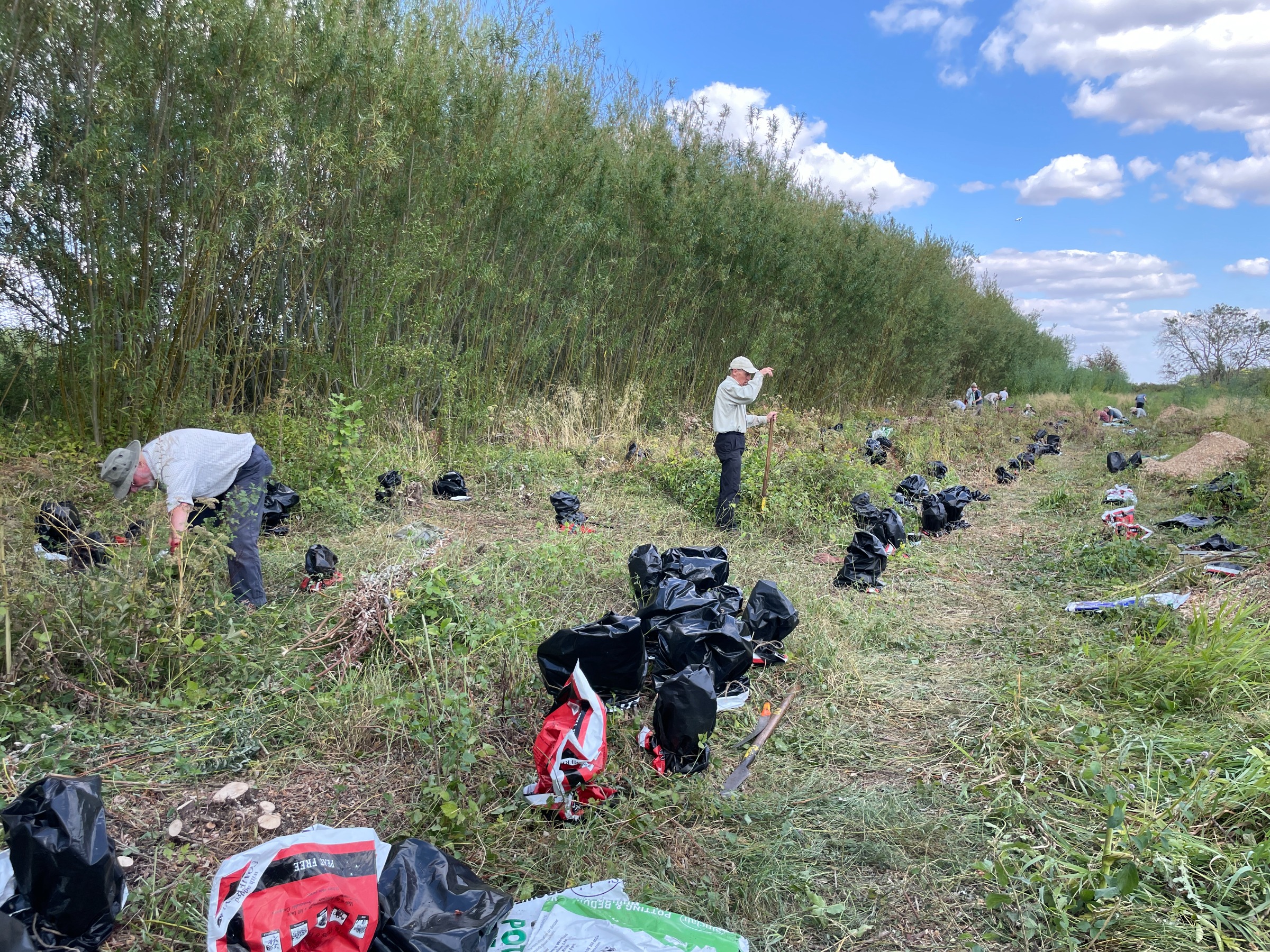 Trialling the re-use of compost bags to kill off the willow stumps
Despite scepticism from some quarters, we experimented with using recycled compost bags and putting them over the coppiced stumps and tying them with string to keep out the light. Within 4 months most trees had lost the will to live and shuffled off to join the great forest in the sky!
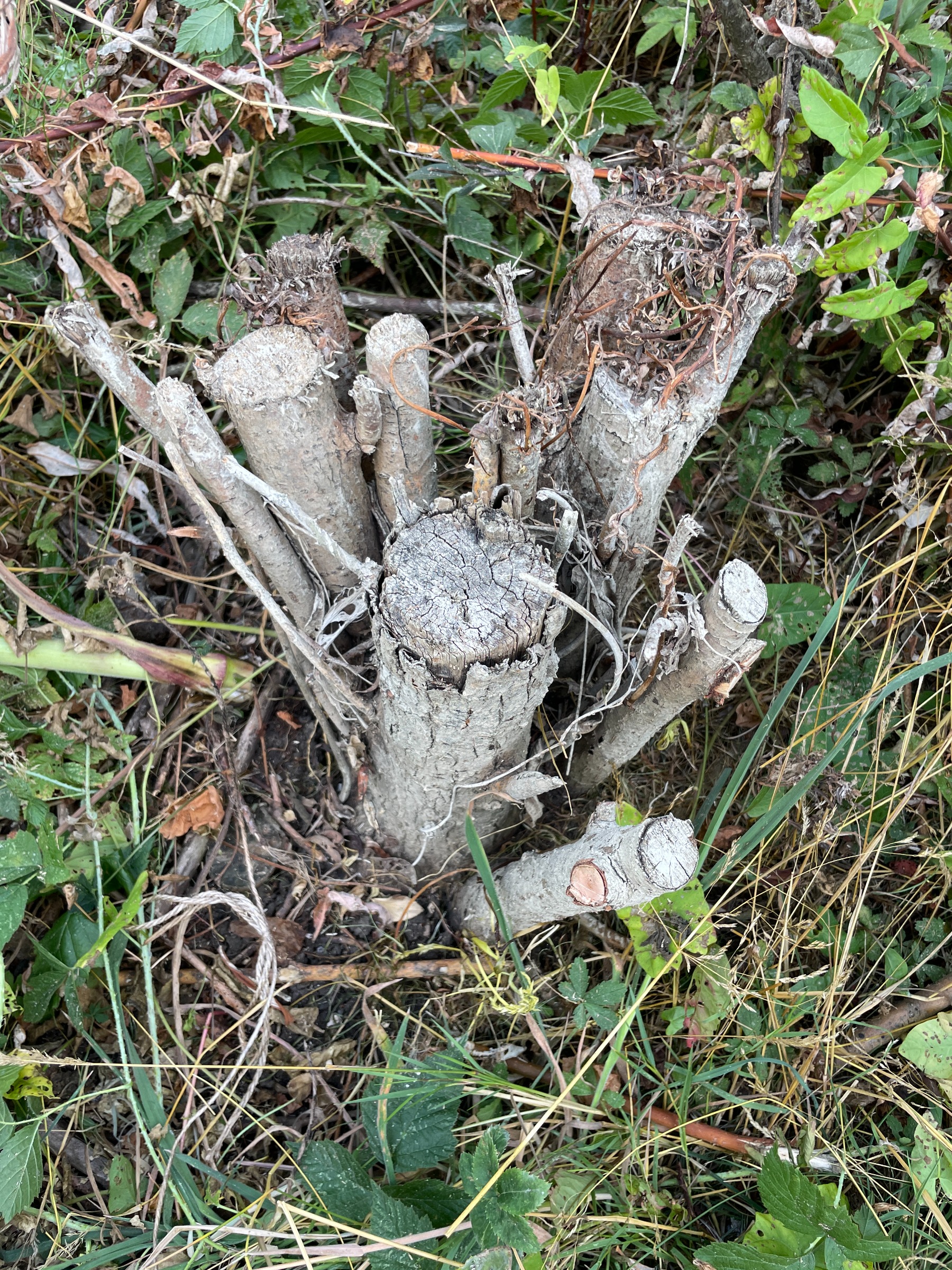 Four months later - success (depending on your point of view, of course)!
Be a part of the story
If trees are your thing - please join us in this amazing, exciting (slightly daunting 😜) new challenge! Our first major task is to clear small areas for planting - the Wednesday team is already getting stuck in and we will be devoting some of our upcoming weekend sessions to the woodland. If you're free on a Wednesday please join us then or come to a weekend session.
As part of our long-term approach, and being keen that the wet woodland grows from the local trees that live around us, we will not be buying-in trees to plant. Instead, we are asking everyone to help us as we grow the wet woodland from locally collected seeds and cuttings.
This is a long-term project so you can take your time, but when you are out on walks and see a tree with ripe seeds (this is the time of year!), please collect them and bring them to us, or sow them at home. Don't be tempted to take seeds from your garden or within our villages as we can't be sure that they weren't sourced from a nursery in another part of the country or even abroad.
By the way, the Beavers are already ahead of the game! They are coming to sow the seeds they have collected around Eynsham on 5th October.
One of the Beavers first seed collection forays for NRN in 2022
We will also be joined on 5th October by Max and Sam from the International Tree Foundation (ITF), who are supporting us to adapt our wildflower nursery to include a tree nursery. ITF acquired funding to support 4 community tree nurseries in Oxfordshire and we are delighted that they have chosen us as their West Oxfordshire Community Tree Nursery. Our partnership will last for three years and will help us grow trees for the Wet Woodland. Any trees that we have spare will be distributed to other community organisation in the District doing similar projects.
Bring along your own collected tree seeds and cuttings to one of our next community restoration days or our regular Wednesday group.
Seeds to collect:
- Ash
- Oak
- Elm
- Hazel
- Crab Apple
- Hawthorn
- Blackthorn
- Buckthorn
- Field Maple
Please remember to:
- Photograph the tree (using GPS enabled picture if possible) and write the location on the packet.
- Keep the seeds cool and dry until bringing them - ideally, in a paper or plastic bag in the fridge.